The printer sitting quietly on your desk today is the result of decades of rapid technological change. What began as mechanical machines the size of furniture has evolved into compact wireless appliances that connect to your phone and receive firmware updates over the internet. Understanding that journey helps you appreciate what your printer can do — and why it sometimes doesn't.
The Early Days of Computer Printing
Early computers needed dedicated printers. The first were mechanical — line printers and teleprinters that hammered characters onto paper using moving parts and ribbon ink. They were industrial in scale and sound, found only in businesses, universities, and government offices.
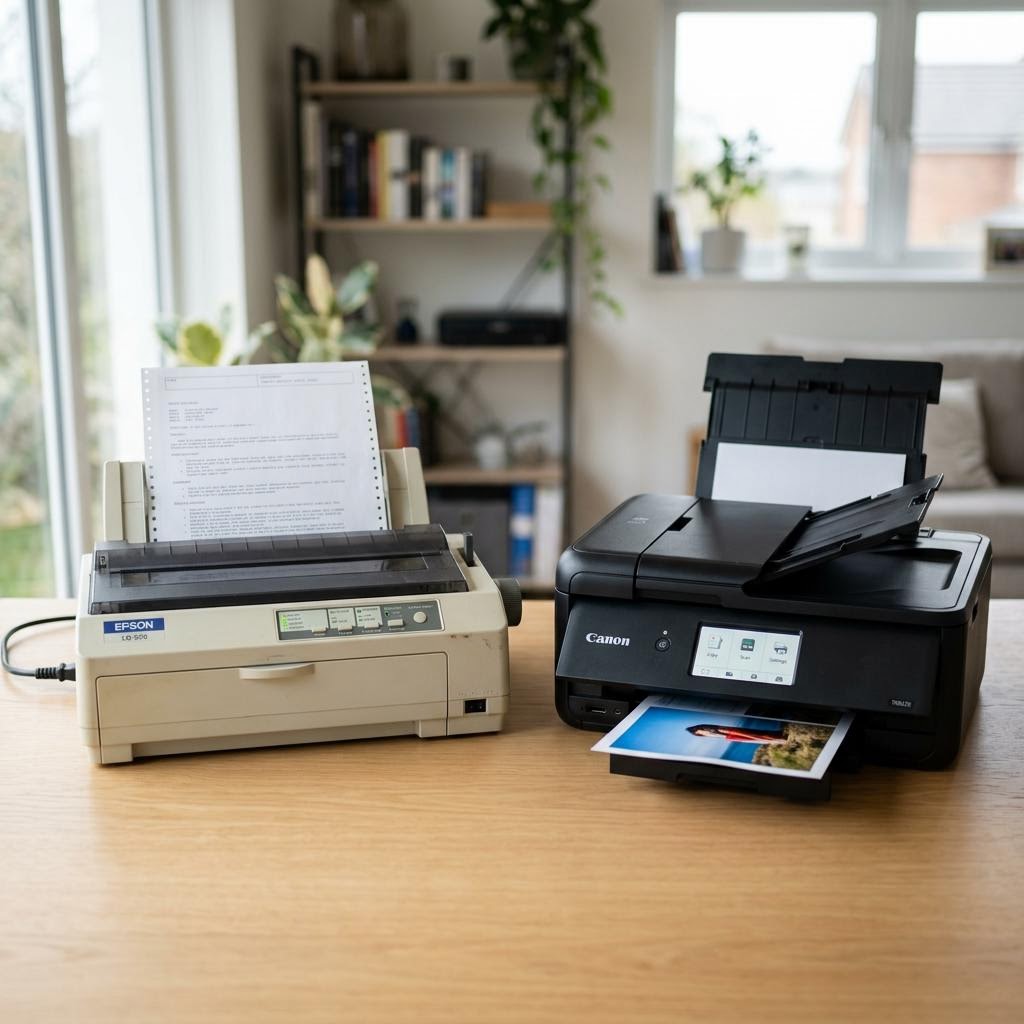
In the 1970s and early 1980s, dot matrix printers became the standard affordable option. These devices used a grid of tiny pins that pressed against an ink ribbon to form letters and shapes one dot at a time. They were noisy and limited in print quality, but they were durable and inexpensive to run.
The Inkjet Revolution
The inkjet printer changed the relationship between homes and printing. Introduced in the late 1980s and popularised through the 1990s, inkjet technology works by spraying microscopic droplets of liquid ink onto paper through tiny nozzles. The result was far cleaner and more detailed than dot matrix output.
Early inkjet models were basic, but they improved rapidly. By the mid-1990s, affordable colour printing became accessible to home users for the first time. Families could print photographs without visiting a shop. Students could print illustrated assignments. Small businesses gained access to colour marketing materials.
The inkjet category diversified significantly. Tank printer systems arrived later, using refillable ink reservoirs rather than disposable cartridges, dramatically reducing the cost per page for high-volume users.
Laser Printing Goes Mainstream
Laser printers operate on an entirely different principle. Instead of spraying ink, they use a laser beam to draw a pattern onto a drum coated with static electricity. Toner powder — a fine plastic-based material — sticks to the charged areas and is then fused onto the page with heat, producing crisp, permanent output.
Developed in the 1970s and commercialised by HP in 1984, laser printing was initially expensive and limited to enterprise environments. Over the following decades, prices fell dramatically, and by the 2000s monochrome laser printers were affordable for small businesses and home office users who prioritised speed and per-page cost over photo quality.
Wireless and Network Printing
For most of printing history, printers were connected to a single computer using a parallel cable, and later USB. Wi-Fi integration changed the relationship permanently. From the mid-2000s onwards, home users could place a printer anywhere in the house and print from any device on the same network.
Technologies such as AirPrint (Apple) and Mopria (Android and Windows) simplified wireless printing further by eliminating the need for custom drivers entirely. Your phone or tablet detects compatible printers automatically and prints without manual configuration.
Cloud Printing and Mobile Devices
Cloud printing extended the wireless model further. Early services like HP ePrint allowed printing from any device, anywhere, by routing jobs through the internet. You could send a document to print from your phone across town and collect the pages when you arrived home.
Today, most manufacturers offer their own connected apps and cloud services. Printers receive firmware updates automatically. Ink subscription services track usage and ship new cartridges before the old ones run out. Mobile printing is now a standard expectation rather than a premium feature.
What the Future Holds
Consumer 3D printing has made the creation of physical objects from digital designs accessible to individuals and small businesses. Sustainability is an increasing focus, with manufacturers developing longer-lasting components, more recyclable materials, and more efficient ink formulas.
As homes and offices become more connected, printers are increasingly part of a broader ecosystem of smart devices rather than standalone machines — and the pace of change shows no sign of slowing.